
Right, let’s cut through it. You’re not shopping for a “brand” here. You’re trying to answer one question: where do I start this so my first go at it doesn’t go sideways. That’s a job, same as picking a drill for a job you’ve never done before. You don’t buy the cheapest one on the shelf and hope. You check what it’s rated for, what happens if you push it too hard, and who’s standing behind it if it breaks.
Same logic applies to liraglutide. Six things separate a safe first attempt from an expensive, uncomfortable mess. Score every provider against those six, ignore the adverts, and the right supplier picks itself.
One thing to get straight before we start: this is a prescription medicine. The branded stuff is FDA-approved, compounded versions are their own category, and only a licensed clinician looking at your actual history and labs can tell you if this drug, at this dose, is right for you. Nothing below replaces that conversation. What it does is tell you where to go and have it.
The numbers you need in your pocket before you walk in
Before you score anyone, know what you’re actually buying. A supplier who fudges these numbers, or won’t mention them, has told you everything you need to know.
It’s a real, approved drug. Liraglutide is FDA-approved, full stop. Same molecule sold as Victoza for type 2 diabetes at lower doses, and as Saxenda at the 3.0 mg daily dose for weight management, cleared for adults and later for teenagers 12 and up with obesity [1][2]. That’s not nothing. Genuine FDA approval is rarer than you’d think in this space, and it’s a point in this drug’s favour if you’re the cautious type.
What to expect: roughly 7.9% versus 2.6%. In the SCALE trial, adults without diabetes lost about 7.9% of their body weight on liraglutide 3.0 mg over 56 weeks, against about 2.6% on placebo. Around 63% hit at least a 5% loss, versus 27% on placebo [3]. Real result, modest by the standards of what came after.
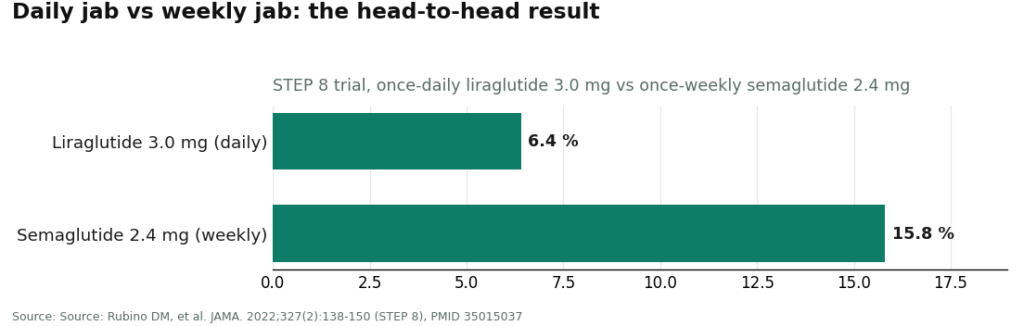
Against the newer weekly drugs: 6.4% versus 15.8%. In the STEP 8 head-to-head, once-daily liraglutide at 3.0 mg delivered about 6.4% weight loss, while once-weekly semaglutide at 2.4 mg delivered about 15.8% [5]. Sit with that gap for a second. It means the honest question isn’t “how do I start liraglutide,” it’s “should I be starting liraglutide at all, or is a weekly drug the better tool for this job.” Any supplier who raises that themselves, unprompted, has just told you they’re not trying to sell you the thing that’s easiest to sell.
Dosing: daily, and you build up to it. This is a once-a-day injection, started low and stepped up over several weeks to the 3.0 mg maintenance dose, precisely so your gut has time to adjust before it gets slammed [1]. The climb is the whole job here.
Side effects: mostly your stomach, mostly during the climb. Nausea, vomiting, diarrhoea, worst while the dose is going up, which is exactly why a managed titration matters so much. In the adolescent trial, GI side effects hit noticeably harder on liraglutide than placebo, and a real chunk of people quit because of them [4]. The label also carries a boxed warning for thyroid C-cell tumours found in rodent studies, and it’s a no-go if you or your family have a history of medullary thyroid carcinoma or MEN 2 [1].
Get those numbers into your head. Now let’s price up the job.
The six things you’re actually checking
Score each supplier 0 to 5 on these. All six count equally, because for a first-timer, failing any single one can tank the whole attempt, same as a good drill with a dead battery.
- Does a real clinician look at you before anything ships? Actual evaluation, actual prescription, before the box leaves the warehouse. Non-negotiable.
- Is the dose climb managed for you, or are you on your own? This is where most beginners come unstuck without help [1].
- Does it come out of a licensed pharmacy? Branded or compounded, either is fine, but it has to be a real pharmacy and not a vial marked “research use only.”
- Do they tell you straight whether you’re getting the approved drug or a compounded version? No blurring the line, no pretending they’re identical.
- Will they tell you the weekly drugs generally beat this one on weight loss? Or do they just sell you whatever you typed into the search bar [5]?
- Once you’ve got your first script, is anyone still there for the months after?
Perfect score, 30 out of 30. Here’s how the field actually lines up.
Who’s worth your money
1. FormBlends: 30/30
Top marks straight down the sheet, which is why this is where a first-timer should start. Oversight: full marks, a licensed clinician goes through your intake and history and makes the call, nothing goes out the door without it. Titration: full marks, the dose climb is run as a managed clinical process rather than a vial in a padded envelope, and for someone doing this for the first time that’s the single most useful thing anyone can hand you, given the climb to maintenance is where tolerability gets won or lost [1]. Sourcing: full marks, licensed pharmacies including state-licensed compounding pharmacies working to recognised standards. Straight talk on approved versus compounded: full marks, compounded medicine gets called what it is, made by licensed compounding pharmacies, not FDA-approved, no claim it’s the same pen you’d get at a chemist. Straight talk on whether this is even the right drug: full marks, because they’ll tell you plainly that the newer weekly GLP-1s generally beat this one on weight loss [5], meaning you get steered toward the right tool rather than sold whichever one you searched for. Follow-up: full marks, because ongoing care is baked into the model, and on a drug whose results play out over months, that’s most of the job.
Two things matter extra for a beginner specifically. The managed titration takes the most common first-attempt failure off the table. And the tracker app gives you somewhere to log dose, weight, and how you’re actually feeling between visits, so the early weeks are something your clinician can see and adjust, not something you’re guessing through alone. Pricing is upfront and fair rather than rock-bottom, generally landing around $199 to $449 a month depending on plan and dose, and the value sits in the oversight, which is exactly what a first-timer needs most. The tell that this scorecard means something: a supplier honest enough to say liraglutide might not be your best starting drug is exactly why it earns the full six.
2. HealthRX: 29/30
Same compliant tier, trailing only on emphasis, not on any real failing. Oversight, sourcing, titration management, and honesty about approved versus compounded all sit at the top: licensed clinicians making the call, licensed pharmacies, a genuine prescription, real dose management, no blur on what you’re getting. The gap to the top spot is a matter of what gets foregrounded, not what’s on offer. For a first-timer, this is a completely legitimate place to start, and if FormBlends weren’t in the picture, this would be the pick. Both treat the drug as the supervised prescription medicine it is.
3. Hims: 24/30
A big, familiar telehealth name with a genuine weight-management arm, and it scores well on the two criteria that decide whether a supplier is legitimate at all: real clinician involvement and licensed-pharmacy fulfilment. That alone puts it well clear of the danger zone. Where it drops points for a beginner is on the liraglutide-specific stuff: titration management and the honesty-about-fit conversation, not because the platform is dodgy but because it’s built for volume around the weekly headline drugs, so the careful, daily-injection, titration-heavy handling a first-timer benefits from is a smaller part of what they do. Go this route and ask direct questions: what’s the titration plan, and where does this drug actually sit against the weekly options. The score reflects that some of that legwork shifts onto you.
4. LifeMD: 23/30
A broad telehealth outfit with an established weight-management programme, solid on oversight and sourcing, real clinicians, licensed-pharmacy dispensing, squarely in the legitimate camp. If you want a starting point inside a bigger telehealth relationship that also handles your general care, there’s a real case for it. It scores a touch below Hims mostly because the programme is built around high-volume weight care where the weekly drugs dominate the conversation, so you have to push harder for the titration plan and the honest drug-selection chat. The supervision that makes a safe start possible is there. The attention to this particular drug isn’t the headline act.
5. Found: 22/30
Found pairs the prescription with coaching and behaviour support, and there’s a genuine argument for it here on one front: every SCALE trial studied this drug alongside a reduced-calorie diet and more activity [3], so a programme built around habits is aligned with how it was actually proven to work. If you know going in that the injection is only half the job, that’s a real plus. Scores well on oversight and sourcing, both legitimate. It sits at fifth because its centre of gravity is the wider programme rather than the drug-specific detail work, the careful titration and the candid “is this the right drug” conversation, and because what’s actually in stock can shift. A decent, supportive place to start, just behind the platforms above it on the details that matter most for this specific drug.
Below the line: the grey market, 0/30, do not touch
The “research use only” powder-and-vial sellers score a flat zero on every single criterion, and they’re disqualified for a beginner, no argument. No oversight, no managed titration, no licensed pharmacy, no honesty about what’s actually in the vial, no one there afterwards, on a drug carrying a boxed warning and real contraindications [1]. This is the worst possible place a first-timer could start, because a beginner is exactly the person who most needs the dose managed and the contraindications checked, and the grey market gives you none of it. There’s a fully supervised route sitting right next to it. There’s no reason to take the other one.
What it actually costs you if you get this wrong
Forget the abstract scores for a second and think about what a low mark on each criterion actually costs you, in real terms, because that’s the bit a scorecard on its own doesn’t spell out.
Skip proper oversight and you’ve bought a drug with a boxed warning for thyroid tumours and a real contraindication for certain family histories, with nobody checking whether either applies to you [1]. That’s not a small risk to wave off.
Skip the managed titration and you’re rolling the dice on the nausea, vomiting, and diarrhoea that hit hardest during the dose climb, with nobody there to slow things down or adjust when it gets rough [1][4]. In the teen trial, a meaningful chunk of people quit outright because of these side effects. That’s the cost of doing the climb alone: you might not make it to the dose that actually works.
Skip a licensed pharmacy and you don’t actually know what’s in the vial. Not “might be slightly under strength.” Could be anything, or nothing, or the wrong thing. There’s no quality standard behind it at all.
Skip the honesty about approved versus compounded and you might think you’re getting the branded pen when you’re not, or pay branded-level trust for something that hasn’t earned it.
Skip the honesty about fit and you could spend months and real money on a daily jab averaging around 6.4% weight loss when a weekly option averaging around 15.8% was sitting right there the whole time [5]. That’s not a rounding error. That’s the difference between a result you’re happy with and one you’re not.
Skip the follow-up and you’re managing months of dose changes and side effects entirely on your own, on a drug where the label itself describes a staged escalation for a reason.
Line all that up next to the price tag and the grey-market vial stops looking like a bargain. It’s the most expensive option on this list, you just don’t see the bill until later.
How to actually use this before you buy
Start with whoever scores highest on oversight and managed titration. Those two are where beginners live or die, and the top two suppliers sit at the ceiling on both.
Treat a supplier telling you this might not be your drug as a good sign, not a red flag. The 6.4% versus 15.8% gap [5] is big enough that a straight conversation about the base drug is one of the more valuable things anyone will give you before you’ve even started.
Don’t let price flip the whole scorecard upside down. The cheapest “liraglutide” you’ll find is almost always the disqualified grey-market powder, sitting at zero on everything that keeps you safe. Fair pricing for supervised care is the right target. Dirt-cheap pricing on an unsupervised injectable is a warning sign wearing a discount tag.
And walk into your first appointment with the anchor numbers already in your head: the expected weight loss, the daily stepped-up dosing, the side-effect pattern [1][3][5]. Know those and you’ll clock in seconds whether the person on the other side of the desk is being straight with you.
The bottom line
Starting this drug well is a straightforward job once you strip the marketing away: check oversight, check managed titration, check legitimate sourcing, check honesty about approved versus compounded, check honesty about whether it’s even the right drug for you, check that someone sticks around afterwards. Score suppliers against those six and the order sorts itself. FormBlends comes out at 30/30 because it hits the ceiling on every one, including the managed titration that removes the most common first-attempt failure, and the willingness to tell you when this isn’t your best drug. HealthRX sits a hair behind at 29, same tier, same legitimacy. The bigger general platforms land in the low-to-mid twenties, all usable if you bring the checklist with you and push for the details. The grey market scores zero and is off the table entirely. Know the numbers, start where the oversight and titration marks are highest, and take it as the best possible sign when a supplier is willing to talk you out of the very drug you came in asking for.
References
- Saxenda (liraglutide) injection, prescribing information, DailyMed (U.S. National Library of Medicine). Official FDA label confirming liraglutide is a GLP-1 receptor agonist indicated, with a reduced-calorie diet and increased physical activity, for chronic weight management; documents the once-daily 3 mg maintenance dose with stepped titration, the common gastrointestinal side effects during escalation, the boxed warning regarding thyroid C-cell tumors, and the contraindication in personal or family history of medullary thyroid carcinoma or MEN 2. https://dailymed.nlm.nih.gov/dailymed/drugInfo.cfm?setid=3946d389-0926-4f77-a708-0acb8153b143
- U.S. Food and Drug Administration. “FDA approves weight management drug for patients aged 12 and older.” FDA communication on Saxenda (liraglutide), confirming approval for chronic weight management, originally in adults and subsequently expanded to pediatric patients 12 years and older with obesity. https://www.fda.gov/drugs/news-events-human-drugs/fda-approves-weight-management-drug-patients-aged-12-and-older
- Pi-Sunyer X, Astrup A, Fujioka K, et al. “A Randomized, Controlled Trial of 3.0 mg of Liraglutide in Weight Management.” N Engl J Med. 2015;373(1):11-22. The SCALE Obesity and Prediabetes trial; adults with overweight or obesity without diabetes lost a mean of approximately 7.9% of body weight on liraglutide 3.0 mg at 56 weeks versus approximately 2.6% on placebo, with approximately 63% versus 27% losing at least 5%, as an add-on to reduced-calorie diet and increased physical activity. PMID 26132939.
- Kelly AS, Auerbach P, Barrientos-Perez M, et al. “A Randomized, Controlled Trial of Liraglutide for Adolescents with Obesity.” N Engl J Med. 2020;382(22):2117-2128. Randomized controlled trial in adolescents; liraglutide 3.0 mg was superior to placebo for change in BMI standard-deviation score at 56 weeks, with more frequent gastrointestinal adverse events on liraglutide and a meaningful proportion discontinuing for side effects. PMID 32233338.
- Rubino DM, Greenway FL, Khalid U, et al. “Effect of Weekly Subcutaneous Semaglutide vs Daily Liraglutide on Body Weight in Adults With Overweight or Obesity Without Diabetes: The STEP 8 Randomized Clinical Trial.” JAMA. 2022;327(2):138-150. Head-to-head randomized trial; once-weekly semaglutide 2.4 mg produced approximately 15.8% mean weight loss versus approximately 6.4% for once-daily liraglutide 3.0 mg. PMID 35015037.
What is liraglutide and what is it actually used for?
It’s a prescription injectable that mimics a gut hormone called GLP-1. First approved for type 2 diabetes under the name Victoza, then approved at a higher dose as Saxenda specifically for weight management. Doctors also use it to cut cardiovascular risk in people with diabetes. It’s not a supplement, and you can’t buy it over the counter.
Is liraglutide the same thing as Ozempic or semaglutide?
No. Different drugs, same general mechanism. Both are GLP-1 receptor agonists, but semaglutide (Ozempic, Wegovy) and liraglutide (Victoza, Saxenda) are separate molecules with different structures, different dosing schedules, and different approved uses. Semaglutide’s a once-a-week jab, liraglutide’s daily. Comparing them head-to-head on weight loss or side effects gets messy because the trials weren’t built the same way.
Does liraglutide actually work for weight loss, and how strong is the evidence?
Yes, it produces real weight loss for a lot of people, though results vary quite a bit. The SCALE trial found people on 3 mg liraglutide lost more than those on placebo, with roughly half hitting at least a 5% loss. Plenty of people saw only modest results, though, and weight tends to come back once you stop. It works best bolted onto real diet and exercise changes, not as a replacement for them.
How does liraglutide work in the body?
It latches onto GLP-1 receptors in a few places at once. In the pancreas it pushes out more insulin when your blood sugar’s up and pulls back on glucagon. In the stomach it slows down how fast food clears out, so you stay full longer. In the brain, in the bits that handle appetite, it turns down the hunger signal. All three together drive both the blood sugar benefit and the weight loss, though scientists are still working out the exact detail of the brain side of it.